
SAFFRON
STORY
Saffronology
Definition
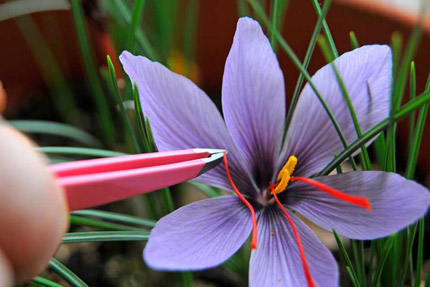
Saffron (pronounced /ˈsæfrən/ or /ˈsæfrɒn/) is a spice derived from the flower of Crocus sativus, commonly known as the "saffron crocus". Saffron crocus grows to 20–30 cm (8–12 in) and bears up to four flowers, each with three vivid crimson stigmas, which are the distal end of a carpel.
The styles and stigmas, called threads, are collected and dried to be used mainly as a seasoning and coloring agent in food. Saffron, long among the world's most costly spices by weight. Saffron's taste and hay-like fragrance result from the chemicals picrocrocin and safranal. It also contains acarotenoid pigment, crocin, which imparts a rich golden-yellow hue to dishes and textiles. Its recorded history is attested in a 7th-century BC Assyrian botanical treatise compiled under Ashurbanipal, and it has been traded and used for over four millennia.
History
Human cultivation and use of saffron spans more than 3,500 years and extends across cultures, continents, and civilizations. Saffron, a spice derived from the dried stigmas of the saffron crocus (Crocus sativus), has through history remained among the world's most costly substances. With its bitter taste, hay-like fragrance, and slight metallic notes, the apocarotenoid-rich saffron has been used as a seasoning, fragrance, dye, and medicine. The saffron crocus is a genetically monomorphic clone native to Southwest Asia; it was probably first cultivated in or near Persia. The wild precursor of domesticated saffron crocus was likely Crocus cartwrightianus, which originated in Crete or Central Asia; The saffron crocus is now a triploid that is "self-incompatible" and male sterile; it undergoes aberrant meiosis and is hence incapable of independent sexual reproduction—all propagation is by vegetative multiplication via manual "divide-and-set" of
Human cultivation and use of saffron spans more than 3,500 years and extends across cultures, continents, and civilizations. Saffron, a spice derived from the dried stigmas of the saffron crocus (Crocus sativus), has through history remained among the world's most costly substances. With its bitter taste, hay-like fragrance, and slight metallic notes, the apocarotenoid-rich saffron has been used as a seasoning, fragrance, dye, and medicine. The saffron crocus is a genetically monomorphic clone native to Southwest Asia; it was probably first cultivated in or near Persia. The wild precursor of domesticated saffron crocus was likely Crocus cartwrightianus, which originated in Crete or Central Asia; The saffron crocus is now a triploid that is "self-incompatible" and male sterile; it undergoes aberrant meiosis and is hence incapable of independent sexual reproduction—all propagation is by vegetative multiplication via manual "divide-and-set" of a starter clone or by interspecific hybridisation. If C. sativus is a mutant form of C. cartwrightianus, then it may have emerged in late Bronze Age Crete. Humans may have bred C. cartwrightianus specimens by screening for specimens with abnormally long stigmas. The resulting saffron crocus was documented in a 7th-century BC Assyrian botanical reference compiled under Ashurbanipal, and it has since been traded and used over the course of four millennia and has been used as treatment for some ninety disorders. The C. sativus clone was slowly propagated throughout much of Eurasia, later reaching parts of North Africa, North America, and Oceania. Global production on a bymass basis is now dominated by Iran, which accounts for some 90% of the annual harvest.

a starter clone or by interspecific hybridisation. If C. sativus is a mutant form of C. cartwrightianus, then it may have emerged in late Bronze Age Crete. Humans may have bred C. cartwrightianus specimens by screening for specimens with abnormally long stigmas. The resulting saffron crocus was documented in a 7th-century BC Assyrian botanical reference compiled under Ashurbanipal, and it has since been traded and used over the course of four millennia and has been used as treatment for some ninety disorders. The C. sativus clone was slowly propagated throughout much of Eurasia, later reaching parts of North Africa, North America, and Oceania. Global production on a bymass basis is now dominated by Iran, which accounts for some 90% of the annual harvest.
Etymology
The ultimate origin of the English word saffron is, like that of the cultivated saffron clone itself, of somewhat uncertain origin. It immediately stems from the Latin word safranum via the 12th-century Old French term safran. The French was borrowed from (za'farān), ultimately from Akkadian azupiranu, "saffron". The Latin form safranum is also the source of the Catalan safrà, Italian zafferano, but Portuguese açafrão, and Spanish azafrán come from the Arabic az-zaferán. The Latin term crocus is certainly a Semitic loan word. It is adapted from the Aramaic form kurkema via the Arabic term kurkum and the Greek intermediate κρόκος krokos, which once again signifies "yellowish". The Sanskrit kunkumam might be in some way related to the Semitic term.
In ancient Persia, saffron (Crocus sativus 'Hausknechtii') was cultivated at Derbena and Isfahan in the 10th century BC. There, Persian saffron threads have been found interwoven
In ancient Persia, saffron (Crocus sativus 'Hausknechtii') was cultivated at Derbena and Isfahan in the 10th century BC. There, Persian saffron threads have been found interwoven into ancient Persian royal carpets and funeral shrouds. Saffron was used by ancient Persian worshippers as a ritual offering to their deities, and as a brilliant yellow dye, perfume, and a medicine. Thus, saffron threads would be scattered across beds and mixed into hot teas as a curative for bouts of melancholy. Indeed, Persian saffron threads, used to spice foods and teas, were widely suspected by foreigners of being a drugging agent and an aphrodisiac. These fears grew to forewarn travelers to abstain from eating saffron-laced Persian cuisine. In addition, Persian saffron was dissolved in water with sandalwood to use as a body wash after heavy work and perspiration under the hot Persian sun. Later, Persian saffron was heavily used by Alexander the Great and his forces during their Asian campaigns. They mixed saffron into teas and dined on saffron rice. Alexander personally used saffron sprinkled in warm bath water, taking after Cyrus the Great. Much like Cyrus, he believed it would heal his many wounds, and his faith in saffron grew with each treatment. He even recommended saffron baths for the ordinary men under him. The Greek soldiers, taken with saffron's perceived curative properties, continued the practice after they returned to Macedonia.
into ancient Persian royal carpets and funeral shrouds. Saffron was used by ancient Persian worshippers as a ritual offering to their deities, and as a brilliant yellow dye, perfume, and a medicine. Thus, saffron threads would be scattered across beds and mixed into hot teas as a curative for bouts of melancholy. Indeed, Persian saffron threads, used to spice foods and teas, were widely suspected by foreigners of being a drugging agent and an aphrodisiac. These fears grew to forewarn travelers to abstain from eating saffron-laced Persian cuisine. In addition, Persian saffron was dissolved in water with sandalwood to use as a body wash after heavy work and perspiration under the hot Persian sun. Later, Persian saffron was heavily used by Alexander the Great and his forces during their Asian campaigns. They mixed saffron into teas and dined on saffron rice. Alexander personally used saffron sprinkled in warm bath water, taking after Cyrus the Great. Much like Cyrus, he believed it would heal his many wounds, and his faith in saffron grew with each treatment. He even recommended saffron baths for the ordinary men under him. The Greek soldiers, taken with saffron's perceived curative properties, continued the practice after they returned to Macedonia.

Standards for Saffron Grading
ISO, a federation of national standards bodies, sets the saffron classification standards. ISO 3632 exclusively deals with saffron and sets up 4 grades of color intensity such as IV (lowest), III, II and I (purest and finest saffron quality).
Saffron Classification gauges the level of 440-nm light absorbency by using samples of dray saffron. High absorbencies mean that there is a high concentration of crocin and high intensity of color. These variables are gauged through spectro-photometer details at testing laboratories around the world.
Persian saffron Classification:
Grade A (Sargol)
• Highest quality
• Strong stigmas
• Highest power in coloring (above 250 USP)
• No broken threads
• Lowest moisture and floral waste amount
• Only has pure and fine stigmas.
Grade B (Thread or Pushal)
• High grade stigmas
• High power coloring (above 225 USP)
• Floral waste is about 2-5% (m/m)
• Most popular kind of saffron in Iran

Quality
How to tell the difference between what's real saffron and what’s fake?
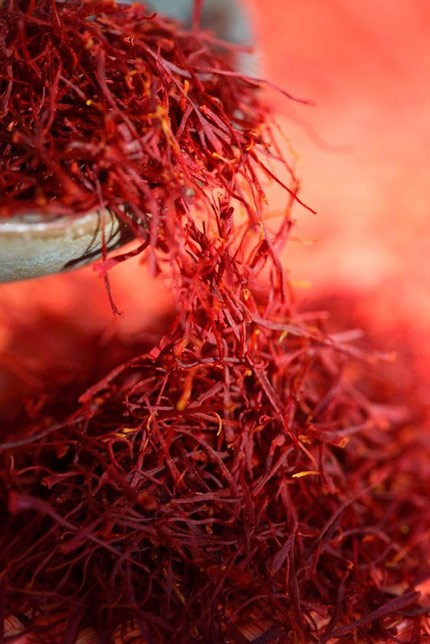
• Saffron stigma threads have a trumpet shape and no matter how it has been harvested the size of saffron stigmas still should hold their trumpet shape.

• It’s always better to buy saffron in stigma form and not the powder or liquid extracts. With 2 spoon full of saffron stigmas you can easily make your own saffron powder.
• If you put a saffron thread/strand in your mouth and if it tastes sweet or salty (good saffron should always smell sweet and never taste sweet) It’s fake. The stigmas can even be made heavier by dipping them in oil, honey, sugar or salt.
• Saffron coloring is another way to tell if you have a good quality of saffron or not. Simply put 4 or 5 saffron stigmas in cold water. Real saffron begins to release its pure yellow pigment and remains that color for 10 to 15 minute. After 30 minutes it begins to turn lightly orange. Fake saffron immediately turns to dark orange and becomes darker once immersed in water.

• After placing saffron stands in half a cup of warm water the shape of saffron stigmas should not change at all and again should keep the trumpet shape even after few days in the water. If you see the saffron is opening even slightly, like a tea leaf, then that is not saffron.
• A very interesting test is to add a little baking soda in water and mix it. Then add saffron to the mixture. The water/baking soda mix shall turn yellow if it’s Pure Saffron. The fake one will turn dim red.
• Sunlight negatively and quickly affects saffron stigmas, which is why it should be harvested before 8am to avoid burning, drying out, loss of fragrance and to keep its maximum flavor. After harvesting, saffron should be dried to prevent molding. In the fake saffron market, in order to reach saffron's true density they add materials such as paraffin, along with food coloring, to add weight. Again after the saffron is placed into water if you see any fat, even a minimum amount on top of the water, that is fake saffron.
• Saffron should not be kept in plastic containers or bags of any kind. The best way to store the saffron is in glass jars or tin containers keeping it in a dark dry place.
Essential to know about Saffron
Saffron is also called “Red gold” as saffron is one of the most precious ingredients in the culinary world.
It takes 130000-250000 flowers for 1 kg of fresh saffron. Each flower produces only 3 stamens which are picked by hand, and dries. For powdered saffron you need hundreds of fine threads. The good thing is for a perfect flavor, you only need very little saffron because otherwise you’ll get a bitter taste.
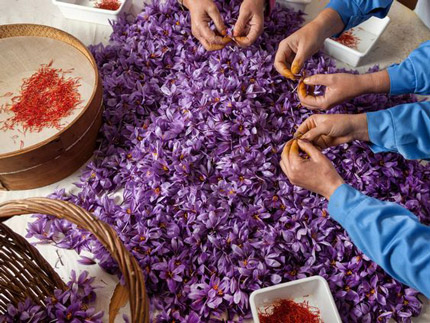
Saffron is a labor intensive crop, which makes it so expensive. It has three delicate crimson stigmas in the center, which are hand-picked, placed on a riddle, and cured over heat to amplify its flavor. Apart from being the most expensive spice, there are many benefits of saffron, which makes it even more special.
How to prepare it?
To draw out the color and to ensure that it's evenly distributed throughout the dish it's to be added to, steep saffron threads in a little warm water, stock, milk or white wine for about 30 minutes before using. Then add the liquid to the dish, usually towards the end of cooking. If you like, you can strain the threads out before you add the liquid, but it's a fiddly job, and the threads look good in any case.
How to store it?
Store saffron in an airtight container in a cool, dry and dark place for up to six months for maximum flavor. Saffron is sensitive to light, so wrap the packet in foil to protect it further. Saffron will not spoil, but it will lose increasingly more and more of its flavor with age.
Saffronology
Definition
Saffron (pronounced /ˈsæfrən/ or /ˈsæfrɒn/) is a spice derived from the flower of Crocus sativus, commonly known as the "saffron crocus". Saffron crocus grows to 20–30 cm (8–12 in) and bears up to four flowers, each with three vivid crimson stigmas, which are the distal end of a carpel.
The styles and stigmas, called threads, are collected and dried to be used mainly as a seasoning and coloring agent in food. Saffron, long among the world's most costly spices by weight. Saffron's taste and hay-like fragrance result from the chemicals picrocrocin and safranal. It also contains acarotenoid pigment, crocin, which imparts a rich golden-yellow hue to dishes and textiles. Its recorded history is attested in a 7th-century BC Assyrian botanical treatise compiled under Ashurbanipal, and it has been traded and used for over four millennia.
History
Human cultivation and use of saffron spans more than 3,500 years and extends across cultures, continents, and civilizations. Saffron, a spice derived from the dried stigmas of the saffron crocus (Crocus sativus), has through history remained among the world's most costly substances. With its bitter taste, hay-like fragrance, and slight metallic notes, the apocarotenoid-rich saffron has been used as a seasoning, fragrance, dye, and medicine. The saffron crocus is a genetically monomorphic clone native to Southwest Asia; it was probably first cultivated in or near Persia. The wild precursor of domesticated saffron crocus was likely Crocus cartwrightianus, which originated in Crete or Central Asia; The saffron crocus is now a triploid that is "self-incompatible" and male sterile; it undergoes aberrant meiosis and is hence incapable of independent sexual reproduction—all propagation is by vegetative multiplication via manual "divide-and-set" of a starter clone or by interspecific hybridisation. If C. sativus is a mutant form of C. cartwrightianus, then it may have emerged in late Bronze Age Crete. Humans may have bred C. cartwrightianus specimens by screening for specimens with abnormally long stigmas. The resulting saffron crocus was documented in a 7th-century BC Assyrian botanical reference compiled under Ashurbanipal, and it has since been traded and used over the course of four millennia and has been used as treatment for some ninety disorders. The C. sativus clone was slowly propagated throughout much of Eurasia, later reaching parts of North Africa, North America, and Oceania. Global production on a bymass basis is now dominated by Iran, which accounts for some 90% of the annual harvest.
Etymology
The ultimate origin of the English word saffron is, like that of the cultivated saffron clone itself, of somewhat uncertain origin. It immediately stems from the Latin word safranum via the 12th-century Old French term safran. The French was borrowed from (za'farān), ultimately from Akkadian azupiranu, "saffron". The Latin form safranum is also the source of the Catalan safrà, Italian zafferano, but Portuguese açafrão, and Spanish azafrán come from the Arabic az-zaferán. The Latin term crocus is certainly a Semitic loan word. It is adapted from the Aramaic form kurkema via the Arabic term kurkum and the Greek intermediate κρόκος krokos, which once again signifies "yellowish". The Sanskrit kunkumam might be in some way related to the Semitic term.
In ancient Persia, saffron (Crocus sativus 'Hausknechtii') was cultivated at Derbena and Isfahan in the 10th century BC. There, Persian saffron threads have been found interwoven into ancient Persian royal carpets and funeral shrouds. Saffron was used by ancient Persian worshippers as a ritual offering to their deities, and as a brilliant yellow dye, perfume, and a medicine. Thus, saffron threads would be scattered across beds and mixed into hot teas as a curative for bouts of melancholy. Indeed, Persian saffron threads, used to spice foods and teas, were widely suspected by foreigners of being a drugging agent and an aphrodisiac. These fears grew to forewarn travelers to abstain from eating saffron-laced Persian cuisine. In addition, Persian saffron was dissolved in water with sandalwood to use as a body wash after heavy work and perspiration under the hot Persian sun. Later, Persian saffron was heavily used by Alexander the Great and his forces during their Asian campaigns. They mixed saffron into teas and dined on saffron rice. Alexander personally used saffron sprinkled in warm bath water, taking after Cyrus the Great. Much like Cyrus, he believed it would heal his many wounds, and his faith in saffron grew with each treatment. He even recommended saffron baths for the ordinary men under him. The Greek soldiers, taken with saffron's perceived curative properties, continued the practice after they returned to Macedonia.
Standards for Saffron Grading
ISO, a federation of national standards bodies, sets the saffron classification standards. ISO 3632 exclusively deals with saffron and sets up 4 grades of color intensity such as IV (lowest), III, II and I (purest and finest saffron quality).
Saffron Classification gauges the level of 440-nm light absorbency by using samples of dray saffron. High absorbencies mean that there is a high concentration of crocin and high intensity of color. These variables are gauged through spectro-photometer details at testing laboratories around the world.
Persian saffron Classification:
Grade A (Sargol)
• Highest quality
• Strong stigmas
• Highest power in coloring (above 250 USP)
• No broken threads
• Lowest moisture and floral waste amount
• Only has pure and fine stigmas.
Grade B (Thread or Pushal)
• High grade stigmas
• High power coloring (above 225 USP)
• Floral waste is about 2-5% (m/m)
• Most popular kind of saffron in Iran
Quality
How to tell the difference between what's real saffron and what’s fake?
• Saffron stigma threads have a trumpet shape and no matter how it has been harvested the size of saffron stigmas still should hold their trumpet shape.
• It’s always better to buy saffron in stigma form and not the powder or liquid extracts. With 2 spoon full of saffron stigmas you can easily make your own saffron powder.
• If you put a saffron thread/strand in your mouth and if it tastes sweet or salty (good saffron should always smell sweet and never taste sweet) It’s fake. The stigmas can even be made heavier by dipping them in oil, honey, sugar or salt.
• Saffron coloring is another way to tell if you have a good quality of saffron or not. Simply put 4 or 5 saffron stigmas in cold water. Real saffron begins to release its pure yellow pigment and remains that color for 10 to 15 minute. After 30 minutes it begins to turn lightly orange. Fake saffron immediately turns to dark orange and becomes darker once immersed in water.
• After placing saffron stands in half a cup of warm water the shape of saffron stigmas should not change at all and again should keep the trumpet shape even after few days in the water. If you see the saffron is opening even slightly, like a tea leaf, then that is not saffron.
• A very interesting test is to add a little baking soda in water and mix it. Then add saffron to the mixture. The water/baking soda mix shall turn yellow if it’s Pure Saffron. The fake one will turn dim red.
• Sunlight negatively and quickly affects saffron stigmas, which is why it should be harvested before 8am to avoid burning, drying out, loss of fragrance and to keep its maximum flavor. After harvesting, saffron should be dried to prevent molding. In the fake saffron market, in order to reach saffron's true density they add materials such as paraffin, along with food coloring, to add weight. Again after the saffron is placed into water if you see any fat, even a minimum amount on top of the water, that is fake saffron.
• Saffron should not be kept in plastic containers or bags of any kind. The best way to store the saffron is in glass jars or tin containers keeping it in a dark dry place.
Essential to know about Saffron
Saffron is also called “Red gold” as saffron is one of the most precious ingredients in the culinary world.
It takes 130000-250000 flowers for 1 kg of fresh saffron. Each flower produces only 3 stamens which are picked by hand, and dries. For powdered saffron you need hundreds of fine threads. The good thing is for a perfect flavor, you only need very little saffron because otherwise you’ll get a bitter taste.
Saffron is a labor intensive crop, which makes it so expensive. It has three delicate crimson stigmas in the center, which are hand-picked, placed on a riddle, and cured over heat to amplify its flavor. Apart from being the most expensive spice, there are many benefits of saffron, which makes it even more special.
How to prepare it?
To draw out the color and to ensure that it's evenly distributed throughout the dish it's to be added to, steep saffron threads in a little warm water, stock, milk or white wine for about 30 minutes before using. Then add the liquid to the dish, usually towards the end of cooking. If you like, you can strain the threads out before you add the liquid, but it's a fiddly job, and the threads look good in any case.
How to store it?
Store saffron in an airtight container in a cool, dry and dark place for up to six months for maximum flavor. Saffron is sensitive to light, so wrap the packet in foil to protect it further. Saffron will not spoil, but it will lose increasingly more and more of its flavor with age.